

Charging via the wall outlet: what do you need?
No charging station nearby? With a mobile charger, you can charge via a regular power outlet or a high-voltage outlet. Here's what you need...
Lees verder


Your car determines how fast it charges, not the cable. Here’s how to choose the right charging cable in three steps: connector, power, and length.

Choosing a charging cable may seem difficult, but it comes down to three questions: which connector does your car have, what power does it charge at the charging station, and how long should the cable be? In this article, we go through them one by one.
Almost all electric cars and plug-in hybrids sold in Europe have a Type 2 connector. Public charging stations in the Netherlands also have a Type 2 socket. So a Type 2-to-Type 2 cable (also called a Mode 3 cable) will almost always fit.
Only a few older models, such as the first Nissan Leaf and the older Mitsubishi Outlander PHEV, still have a Type 1 connector. Not sure? Look behind the charging flap: a Type 2 connector has seven holes and a flat top.
How quickly you charge at a charging station is determined by the charger in your car (the onboard charger). It charges on 1 phase or 3 phases, at 16 or 32 amps. This gives four variants:
| Car charges at | Power | Choose a cable of |
|---|---|---|
| 1 phase, 16A | 3.7 kW | 3.7 kW or higher |
| 1 phase, 32A | 7.4 kW | 7.4 kW or 22 kW |
| 3 phases, 16A | 11 kW | 11 kW or 22 kW |
| 3 phases, 32A | 22 kW | 22 kW |
The rule is simple: the cable must be able to handle at least what your car requires. A heavier-duty cable is always allowed and charges just as quickly. A lighter cable charges more slowly. Pay particular attention to cars that charge on 1 phase at 32A: an 11 kW cable can handle only 16A per phase, so with that cable, such a car charges at only 3.7 kW. Choose a 7.4 kW or 22 kW cable instead.
You can find your car's charging capacity in the manual or on the manufacturer's website. Easier still: use our selection guide. Choose the make, model, and year, and you'll immediately see which cable fits.
A 5-meter cable is enough if your car is parked right next to the charging station, as at most public charging spots. A 10-meter cable is useful if you charge on your own driveway, the charging station is farther away, or you have to reverse into the parking spot. Longer is not always better: a long cable is heavier and takes up more space in the trunk.
A coiled cable rolls itself up, like an old-fashioned telephone cord. It is less likely to lie on the ground or in a puddle and is convenient at public charging stations along the sidewalk. A regular cable is more flexible and easier to roll up in a bag. Both charge equally quickly.
Still not sure? Use the selection guide or view all Type 2 charging cables.

No charging station nearby? With a mobile charger, you can charge via a regular power outlet or a high-voltage outlet. Here's what you need...
Lees verder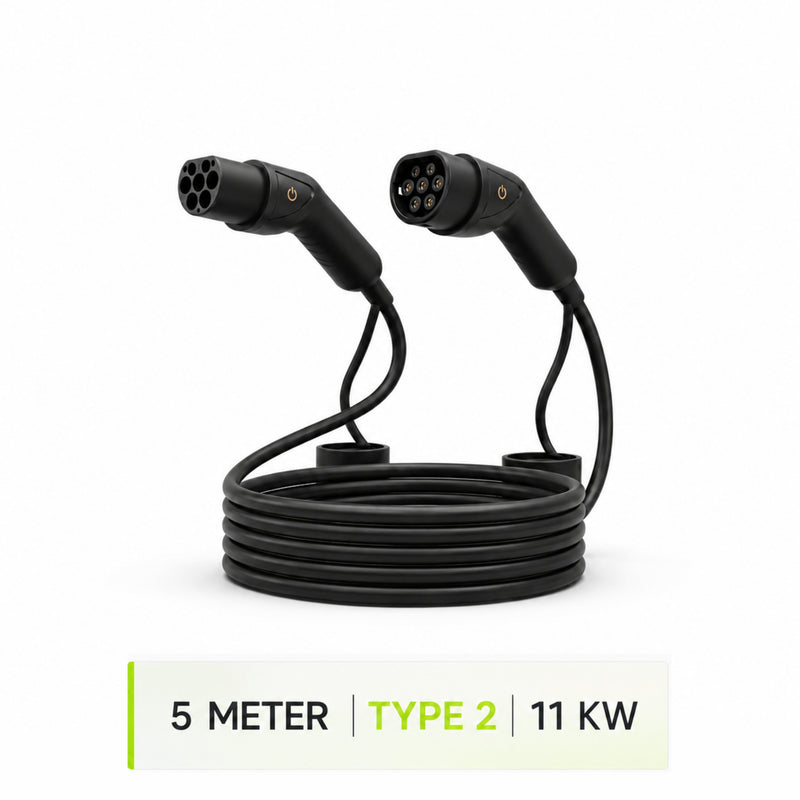
Why does one car charge at 11 kW and another at 7.4 kW? We explain what phases and amps mean and what that tells...
Lees verderYour Cart is Empty...
Your cart may be empty now, but let us help you fill it up with amazing products.